buildcostguide.site – Concrete driveway replacement cost in the US typically ranges per square foot depending on demolition, materials, labor, and site conditions.
Concrete driveways are built to last, but they are not permanent. Years of vehicle traffic, freeze–thaw cycles, soil movement, and surface wear eventually lead many homeowners to consider a full replacement rather than repeated repairs.
The cost of replacing a concrete driveway in the United States is usually calculated per square foot. That pricing structure allows contractors to account for demolition, site preparation, materials, and labor in a way that scales with the size and complexity of the project.
While national averages provide a useful starting point, the final price often varies based on regional labor rates, driveway layout, reinforcement requirements, and finishing options. Understanding how those factors interact can help homeowners estimate realistic budgets before requesting contractor quotes.
Average Concrete Driveway Replacement Cost per Square Foot
Across most US markets, concrete driveway replacement cost generally falls between $8 and $18 per square foot for standard residential installations.
That range usually includes:
Removal of the existing driveway
Hauling and disposal of old concrete
Base preparation
New concrete pouring
Finishing and curing
For a typical two-car driveway measuring around 600 square feet, total project costs commonly land between $4,800 and $10,800.
However, that baseline assumes relatively straightforward site conditions. Homes with steep slopes, limited equipment access, or unstable soil may require additional work that pushes prices beyond the national average.
Regional labor costs also influence pricing. Contractors in metropolitan areas such as the Northeast or West Coast often charge more than those in smaller Midwestern markets, largely due to higher labor and permitting costs.
Because of these variations, many homeowners compare driveway replacement estimates alongside broader property maintenance budgets, often using resources like this comprehensive breakdown of home repair pricing across the US to understand how exterior projects fit into overall maintenance costs.
What the Replacement Process Actually Includes
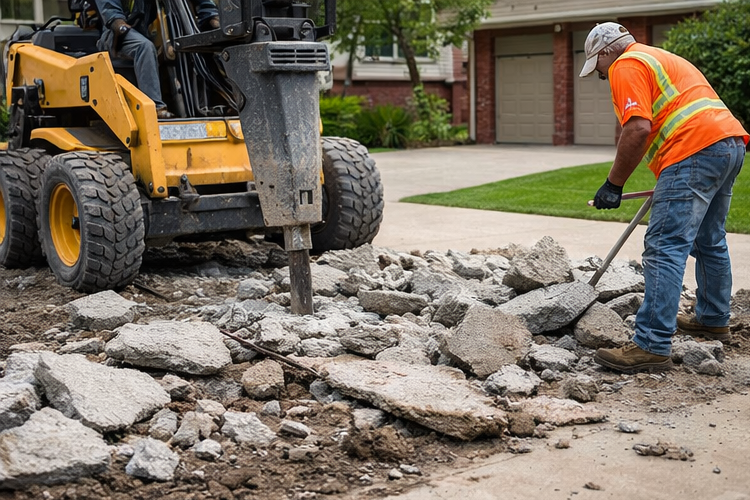
Homeowners sometimes assume that driveway replacement simply involves pouring new concrete over the old slab. In reality, the process is far more involved.
Replacing a driveway requires several distinct steps, each contributing to the final cost.
Demolition and Removal
The first stage involves breaking up and removing the existing concrete slab. Contractors typically use hydraulic breakers or heavy demolition equipment to fracture the surface into manageable pieces.
Disposal costs depend on:
Thickness of the old slab
Accessibility for hauling equipment
Local landfill or recycling fees
In many regions, concrete recycling facilities accept broken slabs for reuse as aggregate, which can reduce disposal expenses slightly.
Excavation and Base Preparation
Once the old slab is removed, the underlying soil must be graded and compacted. Contractors typically install a gravel base layer between 4 and 8 inches thick.
This step is critical for preventing future cracking and settlement. Poor base preparation is one of the most common reasons driveways fail prematurely.
If the soil beneath the driveway is soft or poorly drained, additional stabilization work may be required. That can include deeper excavation, geotextile fabric installation, or thicker aggregate layers.
Formwork and Reinforcement
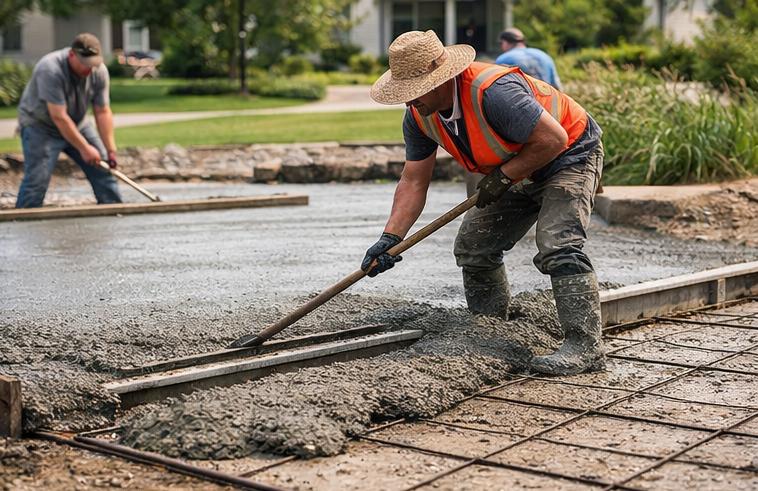
Before pouring the new slab, crews install wooden or metal forms that define the driveway’s shape and edges.
Reinforcement is often added to increase durability. Common options include:
Steel rebar grids
Wire mesh reinforcement
Fiber-reinforced concrete mixes
Reinforcement adds cost but can significantly extend the life of the driveway, especially in regions with harsh winters.
Pouring and Finishing
The final stage involves pouring the concrete and finishing the surface.
Standard residential driveways often use a broom finish, which provides a slightly textured surface that improves traction. More decorative finishes—such as exposed aggregate or stamped concrete—require additional labor and materials.
Once poured, the driveway must cure for several days before it can support vehicles.
Factors That Most Influence Final Costs
Although square footage provides a baseline, several variables can shift the price of a driveway replacement project.
Driveway Thickness
Most residential driveways are poured 4 inches thick, which is sufficient for standard passenger vehicles.
However, homeowners who frequently park trucks, RVs, or heavy equipment may need a 5–6 inch slab, which increases material costs and reinforcement requirements.
Shape and Layout
Straight rectangular driveways are the simplest and cheapest to replace.
Costs increase when driveways include:
Curves or angled sections
Large turnaround areas
Integrated walkways
Decorative borders
Complex layouts require more formwork and additional finishing labor.
Accessibility
Contractors prefer sites where trucks and equipment can easily reach the driveway.
Limited access—such as narrow urban lots or homes with fencing and landscaping barriers—may require smaller equipment or manual labor, increasing overall project costs.
Drainage Requirements
Proper drainage is essential to prevent water pooling or undermining the slab.
If a driveway slopes toward the home or sits in a low area, contractors may need to install:
Drainage channels
Additional grading
Expanded base layers
These adjustments can add several hundred to several thousand dollars depending on the complexity.
Decorative Concrete Finishes
Basic broom-finished concrete sits at the lower end of the price range.
Decorative finishes can increase costs significantly:
Exposed aggregate: +$2–$4 per sq ft
Stamped concrete: +$4–$8 per sq ft
Colored concrete: +$1–$3 per sq ft
Some homeowners choose these finishes to improve curb appeal or match architectural elements of the home.
How Replacement Costs Compare to Other Exterior Upgrades
Driveway replacement is often part of a broader exterior improvement plan. When homeowners update hard surfaces, they sometimes evaluate related upgrades around the same time.
For example, garage access and driveway surfaces tend to age together. When budgeting for exterior projects, some property owners also review the expected price ranges outlined in this analysis of typical garage door installation pricing for single and double garages.
Similarly, driveway work sometimes coincides with siding upgrades or landscaping improvements, since construction equipment may already be on site.
Projects like comparing exterior cladding replacement options across different siding materials are often considered during the same renovation cycle, especially when homeowners aim to improve both structural durability and overall curb appeal.
While these projects are unrelated structurally, grouping them into a single planning phase can sometimes reduce labor mobilization costs.
Regional Price Differences Across the United States
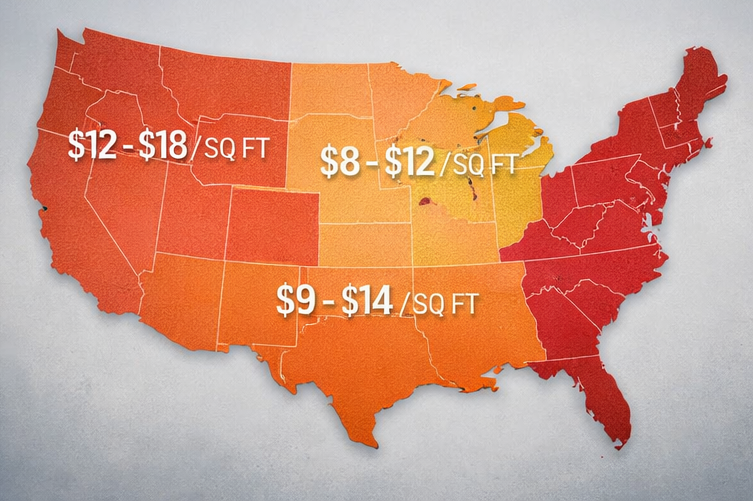
Concrete pricing varies widely across the country due to differences in labor markets, climate conditions, and material transportation costs.
In the Midwest, where concrete suppliers and aggregates are abundant, driveway replacement prices often remain toward the lower end of the national range.
The Northeast and Pacific Coast, on the other hand, tend to see higher project costs due to stricter building codes, higher wages, and expensive permitting processes.
Climate also plays a role. Regions with frequent freeze–thaw cycles require stronger base preparation and expansion joint placement to prevent cracking. Those additional precautions increase labor time and materials.
In contrast, warmer regions in the Southwest and Southeast often experience fewer freeze-related stresses, though soil expansion from moisture can create its own structural challenges.
Because of these differences, homeowners should treat national averages as broad guidelines rather than precise estimates.
Common Cost Misconceptions Homeowners Have
Driveway replacement is a project where misconceptions about cost are fairly common.
One frequent assumption is that repairing cracks is always cheaper than replacement. While minor cracks can sometimes be sealed, extensive cracking or slab movement usually indicates structural issues beneath the surface. In those cases, patching often becomes a short-term fix that eventually leads to full replacement anyway.
Another misunderstanding involves the idea that thinner slabs reduce costs significantly. Contractors may advise against this because thinner concrete can crack or fail under vehicle weight. The small upfront savings may result in earlier repairs or replacement.
Homeowners also sometimes overlook the importance of curing time. Even after the driveway looks dry, the concrete continues strengthening for several days. Driving on the surface too early can cause permanent damage that compromises the slab’s lifespan.
Understanding these details helps explain why replacement costs sometimes appear higher than expected. Much of the expense is tied to structural preparation rather than the concrete itself.
Expected Lifespan of a New Concrete Driveway
When installed correctly, a concrete driveway can last 25 to 40 years.
Longevity depends on several factors:
Quality of base preparation
Climate conditions
Drainage around the driveway
Vehicle weight and usage
Proper sealing and maintenance
Periodic sealing every few years helps protect the surface from moisture infiltration, de-icing salts, and surface scaling.
Even well-installed driveways eventually develop minor cracks as the ground shifts and the concrete ages. However, proper construction significantly delays major structural deterioration.
For many homeowners, that durability is what makes concrete one of the most widely used driveway materials in the United States. Over several decades of use, the long lifespan often balances the relatively high upfront replacement cost compared with alternative materials such as gravel or asphalt.